

Ashfaq Academyof Clinical Medicine

Paediatrics

Pediatric & Neonatal Emergencies

Stay calm and systematic when a child is critically ill.

  • Next batchComing soon
  • FeePKR 3,000
  • FormatLive online + 6-month recordings
  • Time8–10 PM PKT on Zoom · usually alternate days8 PM PKT = 7 PM UAE · 6 PM KSA · 3 PM UK (GMT) / 4 PM UK (BST)

Who can join? Doctors, nurses & allied health professionals

Why this course

What you get

  • Assess a sick child rapidly with the ABCDE approach
  • Recognise and treat shock, including fluid resuscitation
  • Manage severe respiratory distress, status asthmaticus and status epilepticus
  • Follow evidence-based protocols for DKA, poisoning and anaphylaxis
  • Stabilise and safely transfer a critically ill child

Each batch gets a private WhatsApp group where Zoom join links, recordings and case discussions are shared.

Sample certificate

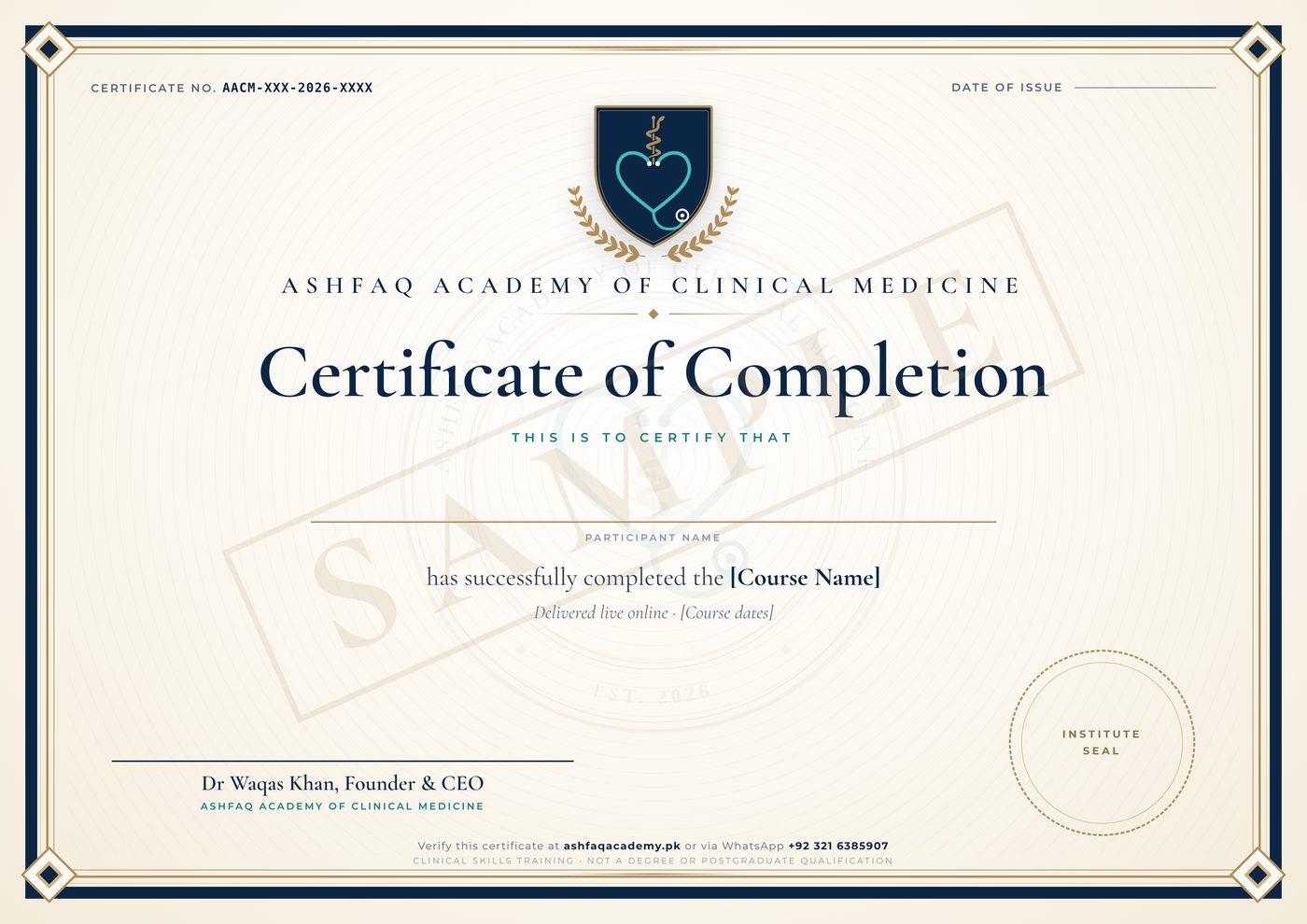
Sample certificate of completion from Ashfaq Academy of Clinical Medicine, marked SAMPLE SAMPLE
Sample certificate of completion (tap to enlarge). Yours carries your name, the course dates, a certificate number, Dr Waqas Khan's signature and the institute seal. PDF
Course details

About this course

Overview

A protocol-driven course for the emergencies that cannot wait. You will practise a systematic ABCDE approach and learn step-by-step management of the most common life-threatening presentations in children and newborns, with drug doses and practical tips for resource-limited settings.

Who it's for
  • Medical officers in emergency departments and paediatric wards
  • House officers
  • Postgraduate trainees in paediatrics, emergency medicine or anaesthesia
  • GPs who see acutely unwell children
  • Nurses and allied health professionals in emergency, ward, NICU and PICU settings

Eligibility: Doctors, nurses and allied health professionals.

Dates, timings & fees
Fee: PKR 3,000. New dates will be announced soon. Register your interest and we'll message you on WhatsApp first.

Timings: 8–10 PM PKT on Zoom · usually alternate days (8 PM PKT = 7 PM UAE · 6 PM KSA · 3 PM UK (GMT) / 4 PM UK (BST)).

Coming soon. Every enrolled student gets 6 months of access to the session recordings. Recorded-only access is also available, with the same 6 months of access: register and choose "Recorded", and we will share the details on WhatsApp.

How you can take it
Curriculum

What we cover

Open a day or module below. Everything is still here — just collapsed so the page stays easy to scan.

  • Live format: 7 sessions of 2 hours, usually on alternate days, 8–10 PM Pakistan time, live on Zoom
  • Built for MBBS graduates, medical officers, FCPS residents and allied health
  • Evidence base: 2025–26 AHA/AAP, ISPAD, WHO & Nelson's
  • Every day ends in two signature blueprints: ready-to-use algorithms with real drug names, real doses and real mL calculations

Day by day

  1. Day 1Recognize the Crashing Child & NewbornAssessment & Resuscitation Foundations2 hours
  2. Day 2Shock, Anaphylaxis & Fluid ResuscitationFrom Compensated Shock to the Fluid-Resistant Child2 hours
  3. Day 3Respiratory Emergencies: Newborn to AdolescentFrom RDS to Status Asthmaticus2 hours
  4. Day 4Neurological Emergencies & The Unconscious ChildSeizures, Coma, and Raised Intracranial Pressure2 hours
  5. Day 5Cardiac, Renal & Metabolic EmergenciesThe Duct-Dependent Newborn to Diabetic Ketoacidosis2 hours
  6. Day 6Infections, Toxicology & Environmental EmergenciesSepsis, Dengue, Poisoning & the First Hour2 hours
  7. Day 7Procedures, Mock Codes & The Exam-Cracking MasterclassBringing Every Day Together — Live2 hours

Full curriculum

Tap a day to see everything it covers, including its two signature blueprints.

Day 1Recognize the Crashing Child & NewbornResuscitation & shock · part 1 of 2 · 2 hours

You'll master

  • The Pediatric Assessment Triangle & ABCDE — spot a sick child in under 60 seconds, at any age
  • The 2025 PALS Systematic Approach Algorithm — initial impression, primary and secondary assessment, in the exact sequence examiners expect
  • 2025 AHA/AAP Pediatric BLS/CPR standards — compression rate, depth, ratios for one- vs. two-rescuer CPR
  • Newborn resuscitation per NRP, 9th Edition (2025) — cord management, PPV, the MR SOPA correction sequence
  • Emergency vascular access — peripheral IV vs. intraosseous (IO): landmarks by age, needle sizing, when to switch
  • Choosing correct equipment sizes fast — ET tube, laryngoscope blade, IO needle — without a length-based resuscitation tape
  • Naloxone for suspected opioid-associated emergencies in children — recognition and weight-based dosing
  • The pre-arrest warning signs most doctors miss — before the monitor tells you
Red flags — do not miss
  • HR not rising despite 30 seconds of effective PPV — correct technique before escalating
  • No spontaneous breathing established by 10 minutes of life
  • Absent femoral pulses or differential cyanosis — think duct-dependent cardiac lesion
  • A lone rescuer delaying the call for help while “just one more minute” of bagging continues

Signature blueprints

The Golden Minute — Newborn Resuscitation (NRP, 9th Ed.)
  1. 0–30 sec: Warm · position · dry & stimulate → assess breathing and heart rate
  2. HR <100 or apnoeic/gasping → begin PPV: 30–60 breaths/min; start in air (21%) at ≥35 weeks, 21–30% O₂ at 32–34 weeks, ≥30% below 32 weeks; SpO₂-guided
  3. No response in 30 sec → run the MR SOPA correction sequence before anything else
  4. HR <60 after effective PPV → chest compressions 3:1 with 100% O₂
  5. HR <60 after 60 sec coordinated CPR → Adrenaline 0.01–0.03 mg/kg IV/IO (1:10,000) — e.g. 0.3 mL for a 3 kg newborn
  6. Volume expansion for shock/blood loss → Normal Saline 10 mL/kg IV/IO over 5–10 min
The Systematic Approach — Pediatric BLS/CPR (2025 AHA/AAP)
  1. Initial impression (5 sec, from the doorway): appearance, work of breathing, circulation/color — decide sick vs. not sick before you touch the child
  2. No breathing/only gasping + no pulse felt in 10 sec → start CPR immediately: 30:2 (one rescuer) or 15:2 (two rescuers)
  3. Compressions: rate 100–120/min, depth ≥⅓ AP chest diameter, allow full recoil, swap the compressor every 2 min
  4. IO access if IV fails within 2 attempts/90 sec — proximal tibia (2 cm below the tuberosity) is the fastest, most reliable site at any age
  5. Add an advanced airway only once compressions and ventilation are well-established — never let intubation interrupt compressions
Pakistan context

Home and BHU deliveries without a radiant warmer — how the 9th-edition priority order changes what you do first.

Exam relevance

Apgar scoring and the NRP flowchart are an FCPS-II and MO-viva fixture — examiners test the sequence, not just the drug.

Consultant's pearl
“The newborn who ‘just needs one more minute’ rarely does — call for help the moment you reach for the bag-mask, not after a minute of struggling alone.”
Day 2Shock, Anaphylaxis & Fluid ResuscitationResuscitation & shock · part 2 of 2 · 2 hours

You'll master

  • Compensated vs. decompensated shock — why a “normal” BP can still mean shock in a child
  • The four shock subtypes at the bedside: hypovolemic, septic/distributive, cardiogenic, obstructive
  • Cold shock vs. warm shock — why the vasopressor choice differs, and what happens if you get it backwards
  • 2025 PALS-aligned fluid resuscitation — physiology-directed boluses, reassessing after every dose
  • Point-of-care markers that actually predict fluid responsiveness — and the ones that don't
  • Anaphylaxis — recognition and the first 10 minutes
  • Massive transfusion principles in pediatric hemorrhagic shock
  • Neonatal shock — sepsis vs. HIE vs. occult blood loss
Red flags — do not miss
  • Narrowing pulse pressure with a still-“normal” systolic BP — late, not reassuring
  • Mottled skin and cap refill >3 sec persisting despite the first fluid bolus
  • Stridor, drooling, or voice change after an allergen — impending airway loss
  • Bounding pulses mistaken for “doing better” — that's warm shock, not recovery

Signature blueprints

Anaphylaxis — First-Hour Stabilization Protocol
  1. Adrenaline 0.01 mg/kg IM (max 0.5 mg), 1:1000, anterolateral thigh — e.g. 0.12 mL for a 12 kg child; repeat every 5–15 min
  2. High-flow O₂ + two IV lines + supine with legs raised (unless vomiting or breathless)
  3. Fluid-refractory hypotension → Normal Saline 20 mL/kg bolus, repeat up to 60 mL/kg
  4. Second-line only — never instead of adrenaline: Hydrocortisone (Solu-Cortef®) 4 mg/kg IV + an antihistamine
  5. Bronchospasm → nebulized Salbutamol (Ventolin® Respirator Solution)
  6. Observe a minimum of 6–8 hours — warn every family about biphasic reactions before discharge
Cold Shock vs. Warm Shock — The Vasopressor Decision
  1. Cold shock (narrow pulse pressure, weak pulses, cap refill >3 sec, mottled) → Adrenaline infusion 0.05–0.3 mcg/kg/min, titrate to perfusion
  2. Warm shock (bounding pulses, wide pulse pressure, flash cap refill — classic early septic shock) → Noradrenaline infusion 0.05–0.3 mcg/kg/min
  3. Start peripherally through a large vein if central access isn't ready — don't delay vasoactive support waiting for a line
  4. Reassess perfusion, lactate, and urine output every 15 min — the picture can flip from warm to cold shock as the child decompensates
  5. Fluid- and catecholamine-resistant shock → consider hydrocortisone for possible relative adrenal insufficiency, and escalate to PICU
Pakistan context

Why adrenaline is so often under-dosed or delayed in Pakistani emergency rooms — and the auto-injector-unavailability workaround.

Exam relevance

Shock-subtype tables and the anaphylaxis algorithm are guaranteed SEQ and viva material.

Consultant's pearl
“A capillary refill you had to think twice about is already abnormal — trust your first impression, not your second-guess.”
Day 3Respiratory Emergencies: Newborn to AdolescentRespiratory emergencies · 2 hours

You'll master

  • Newborn respiratory distress at a glance — RDS vs. TTN vs. MAS vs. PPHN in five bedside questions
  • CPAP basics — when it's enough, and when it isn't
  • Acute severe asthma / status asthmaticus — severity staging and the treatment stepladder
  • The Westley Croup Score — and why every child gets a steroid regardless of severity
  • Bronchiolitis — what actually changes outcome, and what's just tradition
  • High-flow nasal cannula — what the evidence actually shows, and where it fits
  • Foreign body aspiration — red flags, positioning, and when to intervene
  • Pediatric NIV/CPAP failure criteria — recognizing when it's time to intubate
Red flags — do not miss
  • A “silent chest” in a struggling asthmatic — exhaustion, not improvement
  • Grunting, head bobbing, or see-saw breathing in a young infant
  • Sudden stridor with drooling — think foreign body/epiglottitis; do not examine the throat
  • A “quiet” tachypneic infant with retractions — quiet doesn't mean stable

Signature blueprints

Status Asthmaticus — The Treatment Stepladder
  1. Salbutamol (Ventolin®) 0.15 mg/kg/dose (min 2.5 mg) nebulized with O₂, back-to-back ×3 in the first hour
  2. + Ipratropium bromide (Atrovent®) 250–500 mcg nebulized with each of the first 3 doses
  3. Early steroid, don't delay — Hydrocortisone (Solu-Cortef®) 4 mg/kg IV or Dexamethasone (Decadron®) 0.6 mg/kg
  4. Severe / impending failure → MgSO₄ 50 mg/kg IV over 20 min (max 2 g)
  5. Still failing → IV Salbutamol infusion + senior/HDU review — silent chest and exhaustion mean escalate now
Croup — The Westley Score & Treatment Algorithm
  1. Score stridor, retractions, air entry, cyanosis, and consciousness — mild (≤2), moderate (3–5), severe (6–11), impending respiratory failure (≥12)
  2. Every child, any severity → Dexamethasone (Decadron®) 0.15–0.6 mg/kg PO/IM/IV, single dose — cuts return visits and admissions
  3. Moderate–severe → add nebulized Adrenaline 0.5 mL/kg of 1:1000 (max 5 mL); observe 2–4 hours after — rebound is real
  4. Severe/impending failure → heliox trial, prepare for a smaller-than-expected ET tube, senior anaesthesia input early
  5. Discharge only after stridor-free at rest for the full observation window — not just “looking better”
Pakistan context

Winter RSV/bronchiolitis surges in Lahore and Karachi EDs, and biomass-fuel indoor air pollution as a distinct pediatric asthma trigger.

Exam relevance

Asthma severity classification plus the stepladder is one of the most repeated FCPS-II SEQs on the paper.

Consultant's pearl
“The quiet tachypneic infant worries me more than the loud wheezy one — noise is often reassurance in disguise.”
Day 4Neurological Emergencies & The Unconscious ChildNeurological emergencies · 2 hours

You'll master

  • Neonatal seizures vs. jitteriness — the bedside discriminator examiners ask every year
  • GCS and AVPU in children — the modified infant scoring
  • Status epilepticus — the timed drug ladder, minute by minute
  • Recognizing raised ICP and the herniation red flags
  • Raised ICP first-hour management — positioning, fluids, and when to reach for hyperosmolar therapy
  • Meningitis — when to do an LP, when NOT to, and antibiotic timing that shouldn't wait for it
  • Simple vs. complex febrile seizures — and when you actually need to worry
  • Non-accidental head injury — the red flags that should change your differential
Red flags — do not miss
  • Any seizure still going at 5 minutes — start the ladder, don't “wait and see”
  • Cushing's triad — bradycardia, hypertension, irregular breathing — means herniation is near
  • A bulging fontanelle with fever in an infant — treat as meningitis until proven otherwise
  • Retinal hemorrhages or an inconsistent injury history in an infant — think non-accidental injury

Signature blueprints

Status Epilepticus — The Timed Drug Ladder
  1. 0–5 min: ABC, O₂, immediate glucose check — treat hypoglycemia first with D10W 2 mL/kg IV
  2. 5 min: Midazolam (Dormicum®) 0.15 mg/kg IV/IO, max 10 mg (2.25 mg for a 15 kg child) — or, if no access, 0.3 mg/kg buccal/intranasal, max 10 mg (4.5 mg for a 15 kg child)
  3. 10 min, still fitting → repeat the benzodiazepine once: Diazepam (Valium®) 0.3 mg/kg IV, max 10 mg
  4. 20 min → Phenytoin 20 mg/kg IV loading (max 2 g) over at least 20 min (no faster than 1 mg/kg/min) with cardiac monitoring, or Valproate 40 mg/kg IV
  5. 40 min, refractory → Phenobarbitone 20 mg/kg IV, call for RSI and ICU — keep hunting the cause in parallel
Raised Intracranial Pressure — The First-Hour Algorithm
  1. Head up 30°, head and neck midline — simple positioning that measurably lowers ICP
  2. Maintain normotension and normothermia — treat fever aggressively; avoid hypotonic fluids, run isotonic (0.9% NS) maintenance
  3. Brief hyperventilation (target PaCO₂ 30–35 mmHg) only as a short bridge — never sustained therapy
  4. Signs of herniation → Mannitol 0.5–1 g/kg IV over 20 min, or 3% Hypertonic Saline 3–5 mL/kg over 10–20 min
  5. Urgent CT + neurosurgical consult in parallel — don't let imaging delay the first dose of hyperosmolar therapy
Pakistan context

Delayed presentation after home remedies, and the febrile-seizure-vs-dengue/malaria-encephalopathy overlap.

Exam relevance

A timed-ladder answer is exactly the structure FCPS-II examiners are trained to award full marks for.

Consultant's pearl
“A ‘first seizure’ history is often the second or third — ask specifically about staring spells and odd jerks, not just convulsions.”
Day 5Cardiac, Renal & Metabolic EmergenciesCardiac, renal & metabolic emergencies · 2 hours

You'll master

  • The duct-dependent neonate — recognizing critical CHD before collapse, and the prostaglandin save
  • Recognizing critical CHD before the pulse oximeter does — the pre-ductal/post-ductal saturation trick
  • Pediatric SVT vs. sinus tachycardia — the discriminator table
  • 2025 PALS bradycardia/tachycardia algorithms — vagal maneuvers → adenosine → synchronized cardioversion
  • DKA in children — the ISPAD 2022-aligned fluid and insulin protocol, and how cerebral edema actually happens
  • Hyperkalemia's ECG progression — and the stabilize-shift-eliminate sequence
  • Recognizing pediatric AKI early — pre-renal, renal, and post-renal at the bedside
  • Cerebral edema in DKA — the warning signs that mean stop and reassess immediately
Red flags — do not miss
  • Absent femoral pulses in a newborn — never dismiss as “technical difficulty”
  • HR >220/min in an infant — think SVT, not sinus tachycardia
  • Kussmaul breathing and a fruity odor in a child labelled “gastroenteritis” — check glucose now
  • Headache, bradycardia, and rising BP during DKA treatment — stop and treat as cerebral edema

Signature blueprints

SVT, Stable Narrow-Complex — The Algorithm
  1. Vagal maneuvers first — ice-to-face in infants, Valsalva/carotid massage in the older child
  2. Adenosine (Adozin®) 0.1 mg/kg rapid IV push (max 6 mg) — fastest available line + immediate rapid saline flush
  3. No response → repeat at 0.2 mg/kg (max 12 mg)
  4. Unstable or no IV access → synchronized cardioversion 0.5–1 J/kg, then 2 J/kg
  5. Third-line, specialist input → Amiodarone (Cordarone®) 5 mg/kg IV over 20–60 min
Diabetic Ketoacidosis — The Complete Fluid & Insulin Protocol
  1. Grade severity by pH/bicarbonate: mild (pH 7.2–7.3), moderate (7.1–7.2), severe (<7.1) — sets your urgency, not just your labs
  2. Shock → 0.9% saline 20 mL/kg as fast as possible, reassessing after each bolus and repeating as needed; volume-depleted but not in shock → 0.9% saline 10–20 mL/kg over 20–30 min — then replace the remaining deficit plus maintenance evenly over 24–48 hours
  3. Start insulin infusion 0.05–0.1 U/kg/hr (Humulin® R / Actrapid® HM) a full hour after fluids begin — never as a bolus, never before fluids
  4. Add dextrose once glucose falls below ≈250–300 mg/dL — keep the insulin running, don't stop it to “fix” the glucose
  5. Add K⁺ to fluids once the level is known and urine output is confirmed, even if initially high-normal — insulin will drop it fast
  6. Cerebral edema suspected → Mannitol 0.5–1 g/kg IV over 10–15 min (or 3% saline 2.5–5 mL/kg over 10–15 min), slow the fluid rate, call PICU immediately
Pakistan context

New-onset Type 1 diabetes is still often misread as gastroenteritis or pneumonia — the diagnostic delay that turns a new diagnosis into a DKA admission.

Exam relevance

The SVT algorithm and the DKA fluid/insulin calculation are the two most-tested acute-care numeracy stations.

Consultant's pearl
“If a ‘gastroenteritis’ child is breathing too well for how sick they look, check a blood gas before anything else — that's Kussmaul breathing, not comfort.”
Day 6Infections, Toxicology & Environmental EmergenciesInfections, toxicology & other emergencies · 2 hours

You'll master

  • Pediatric sepsis under the brand-new 2026 Surviving Sepsis Campaign (Pediatric) framework
  • Dengue's three phases — febrile, critical, recovery — and the fluid-management trap in each
  • WHO dengue classification, warning signs, and the fluid-leak-phase trap
  • Meningococcemia and the non-blanching rash red flags
  • The sick infant with fever and no source — which cultures, which empirical antibiotics, and when to hold off
  • Organophosphate poisoning and the atropinization endpoint
  • Common Pakistani pediatric poisonings, corrosive ingestion, and burns — first-hour priorities
  • Snake bite in Pakistani children — when antivenom is indicated, and when it isn't
Red flags — do not miss
  • A non-blanching rash with fever — treat as meningococcemia until proven otherwise
  • Rising hematocrit with falling platelets in dengue — the critical leak phase has begun
  • Miosis, excess secretions, and bradycardia — organophosphate poisoning; start atropine early
  • Looking “best” on day 4 of dengue — defervescence often means the leak phase is starting, not ending

Signature blueprints

Pediatric Septic Shock — 2026 Surviving Sepsis-Aligned Bundle
  1. 0–5 min: recognize (altered mental status + poor perfusion/hypotension) → high-flow O₂, two points of IV/IO access
  2. Fluid bolus 10 mL/kg crystalloid over 10–20 min — reassess after every bolus; stop at signs of overload, not a fixed volume
  3. Within 60 min, after cultures → Ceftriaxone (Getofin® / Cefxone®) 80–100 mg/kg/day IV ± an aminoglycoside if resistant-organism risk
  4. Fluid-refractory shock → start a vasoactive infusion (adrenaline or noradrenaline) early, rather than repeated boluses
  5. Source control + reassess every 15 min: HR, perfusion, mental status, and lactate if available
Organophosphate Poisoning — The Complete Management Algorithm
  1. Decontaminate first — remove clothing, wash skin, protect yourself with gloves/apron; OP absorbs through intact skin
  2. Airway and breathing take priority — secretions may need repeated suctioning; intubate early if respiratory failure develops
  3. Atropine 0.02–0.05 mg/kg IV every 5 min, doubling the dose each time until atropinized: clear chest on auscultation, HR above 80–100 depending on age, systolic BP >80 mmHg (age-appropriate), dry axillae and pupils no longer pinpoint — that's atropinization, not a fixed dose
  4. Pralidoxime (2-PAM) 25–50 mg/kg IV over 30 min, then repeat/infuse — most effective within 24–48 hr of exposure
  5. Watch for intermediate syndrome at 24–96 hours — proximal muscle weakness and respiratory failure that can follow apparent recovery
Pakistan context

Post-monsoon dengue surges across Punjab, agricultural organophosphate exposure, and kerosene/corrosive household poisoning.

Exam relevance

The 2026 bundle is brand-new — knowing it ahead of your examiner is a genuine, rare edge.

Consultant's pearl
“The dengue patient who looks best on day 4 is often about to look worst on day 5 — defervescence is exactly when the leak phase begins.”
Day 7Procedures, Mock Codes & The Exam-Cracking MasterclassPractical integration & exam mastery · bonus day · 2 hours

You'll master

  • Core procedural skills every on-call doctor needs — IO insertion, bag-mask technique, DC shock energy dosing
  • The complete Pediatric Cardiac Arrest Algorithm (2025 AHA/AAP PALS) — shockable and non-shockable pathways
  • Rapid sequence intubation for the ward/ER doctor — preparation, drugs, and the “killer confirmation”
  • Live mock-code walkthroughs — real scenarios, audience-driven decisions, real-time correction
  • Post-resuscitation care — the first hour after ROSC that determines the outcome
  • FCPS-II / MO-viva exam technique — how examiners actually score a resuscitation answer
  • Building a structured answer for any emergency SEQ, in under 30 seconds of thinking time
  • Your own weight-based emergency drug-dose cheat-sheet — built live, ready to save to your phone
Red flags — do not miss
  • Naming a drug without stating its dose — an automatic mark lost in every viva
  • Skipping the systematic ABCDE opening to “jump to the diagnosis”
  • Forgetting to reassess after every single intervention — examiners watch for this specifically
  • Choosing succinylcholine without checking for burns, crush injury, or neuromuscular disease first

Signature blueprints

Pediatric Cardiac Arrest — 2025 AHA/AAP PALS Algorithm
  1. High-quality CPR throughout: rate 100–120/min, depth ≥⅓ AP chest diameter, compression fraction >60%, pauses <10 sec
  2. Shockable, VF/pulseless VT → defibrillate 2 J/kg → 4 J/kg → ≥4 J/kg (max 10 J/kg); Adrenaline after the 2nd shock; Amiodarone (Cordarone®) 5 mg/kg after the 3rd
  3. Non-shockable, PEA/asystole → Adrenaline 0.01 mg/kg IV/IO (0.1 mL/kg of 1:10,000) every 3–5 min, started early
  4. Post-ROSC → target BP above the 10th centile for age, avoid hyperoxia and hyperthermia, hunt the 4 H's and 4 T's
Rapid Sequence Intubation — The Ward/ER Doctor's Sequence
  1. Prepare with SOAP-ME — suction, oxygen, airway kit sized correctly, drugs drawn up, monitoring on, equipment for a failed airway ready
  2. Pre-oxygenate with 100% O₂ for 3 minutes (or 8 vital-capacity breaths) before touching the airway
  3. Induction: Ketamine 1–2 mg/kg IV (favoured in shock/asthma) or Midazolam 0.1–0.3 mg/kg IV
  4. Paralysis: Rocuronium 1–1.2 mg/kg IV (avoids succinylcholine's hyperkalemia risk) or Succinylcholine 1–2 mg/kg IV if no contraindication
  5. Confirm placement with waveform capnography — the one confirmation that doesn't lie; keep a supraglottic airway ready as backup
Why it's different

Every scenario is drawn from real Pakistani EDs and NICUs — not generic textbook vignettes.

You leave with

A certificate of completion (issued within 7 days of the final class), 6 months of access to all 7 session recordings, and membership of our free WhatsApp case-discussion group.

Consultant's pearl
“The best resuscitationist in the room is usually the one asking for help earliest, not the one working hardest alone.”
Why this curriculum is differentBlueprints, Pakistani practice, current guidance, exam + bedside
  • Exact blueprints, not theory: Every day ends in two ready-to-use algorithms — real drug names, real doses, real mL calculations.
  • Built for Pakistani practice: Local brand names, local disease burden, and the resource-limited-setting decisions your exam (and your ER) actually ask for.
  • Current to 2025–26: NRP 9th Ed., 2025 AHA/AAP PALS, and the brand-new 2026 Pediatric Surviving Sepsis Campaign — ahead of most textbooks in print.
  • Exam + bedside, together: Every topic is mapped to how FCPS-II and MO viva examiners actually score a resuscitation answer.

Curriculum cross-referenced against NRP (9th Ed.) · 2025 AHA/AAP PALS & CPR-ECC Guidelines · 2026 Surviving Sepsis Campaign (Pediatric) · ISPAD 2022 · WHO/IMNCI · Nelson's Textbook of Pediatrics.

Everything includedLive sessions, recordings, dose cheat-sheet, case group, certificate
  • 7 live 2-hour sessions
  • All session recordings, with 6 months of access
  • Weight-based dose cheat-sheet
  • Free WhatsApp case-discussion group for all members
  • Certificate of completion, issued within 7 days of the final class
Faculty

Who teaches this course

Meet the faculty
Portrait of Dr Waqas Khan, Head of Paediatrics
Head of Paediatrics

Dr Waqas Khan

Founder & CEO
  • MBBS
  • FCPS (Paediatrics)

Dr Waqas Khan founded the academy to make high-quality, practical medical education affordable for doctors, nurses and allied health professionals across Pakistan. He leads all paediatrics teaching.
Try before you register

Sample lecture & notes

Sample lecture
Sample notes

A preview of the notes you'll receive with this course.

Sample notes coming soon
FAQs

Common questions

When will this course start?

This course is coming soon; dates have not been set yet. Register your interest and we will message you on WhatsApp as soon as they are confirmed.

Who can join?

Doctors, nurses and allied health professionals who manage sick children or newborns, from house officers to consultants, and emergency, ward and NICU nurses.

How is the course run?

Seven live classes on Zoom, 8–10 PM Pakistan time, usually on alternate days (not consecutive). Batches are kept small for individual attention, and every session is recorded.

What is the fee?

The fee is a fixed PKR 3,000 for the 7-session course. There is no early-bird offer.

Is this a certified life-support course (e.g. PALS)?

No. It is a clinical skills training course that follows current resuscitation guidance, but it is not an official PALS/APLS certification.

Sample certificate of completion from Ashfaq Academy of Clinical Medicine, marked SAMPLE SAMPLE
Sample certificate of completion (tap to enlarge). Yours carries your name, the course dates, a certificate number, Dr Waqas Khan's signature and the institute seal. PDF
Will I get a certificate?

Yes, a certificate of completion, issued within 7 days of the final class. This is clinical skills training, not a PMDC/HEC-recognised degree or postgraduate qualification.

Sample certificate of completion from Ashfaq Academy of Clinical Medicine, marked SAMPLE SAMPLE
Sample certificate of completion (tap to enlarge). Yours carries your name, the course dates, a certificate number, Dr Waqas Khan's signature and the institute seal. PDF
Will I get the recordings?

Yes. Every enrolled student gets 6 months of access to the session recordings, so a missed class is never a missed topic.

Is there a case-discussion group?

Yes. All members can join our free WhatsApp case-discussion group.

Do returning students get a discount?

Yes. If you have attended any of our courses or workshops before, you get a discount on your next one. Please ask us on WhatsApp for the current discount.

How do I get the Zoom link and recordings?

Each batch has its own private WhatsApp group. Zoom join links, recordings and case discussions are shared there. You are added once your payment is confirmed.

I live outside Pakistan. Can I join?

Yes, overseas students are welcome. 8 PM Pakistan time is 7 PM in the UAE, 6 PM in Saudi Arabia and 3 PM in the UK in winter (GMT), or 4 PM during British Summer Time. Register with your own country code and pay by JazzCash, Easypaisa or UBL bank transfer.

How do I register and pay?
  1. Fill in the registration form and choose your course. You will get a reference number such as AACM-261019-AB12.
  2. Send the course fee to one of our accounts: JazzCash: 03216385907 (Waqas Khan); Easypaisa: 03216385907 (Waqas Khan); UBL (United Bank Limited): account title Waqas Khan, account no. 0381318599799, IBAN PK33UNIL0109000318599799. Please write your reference number in the transfer note.
  3. Upload your payment receipt (image or PDF, up to 8 MB) with the transaction ID.
  4. We verify your payment and confirm your seat on WhatsApp. You can download a PDF of your registration straight away.

Courses marked 'Coming soon' only need a short 'register interest' form; there is no payment until dates are announced.

Course poster

Share this course

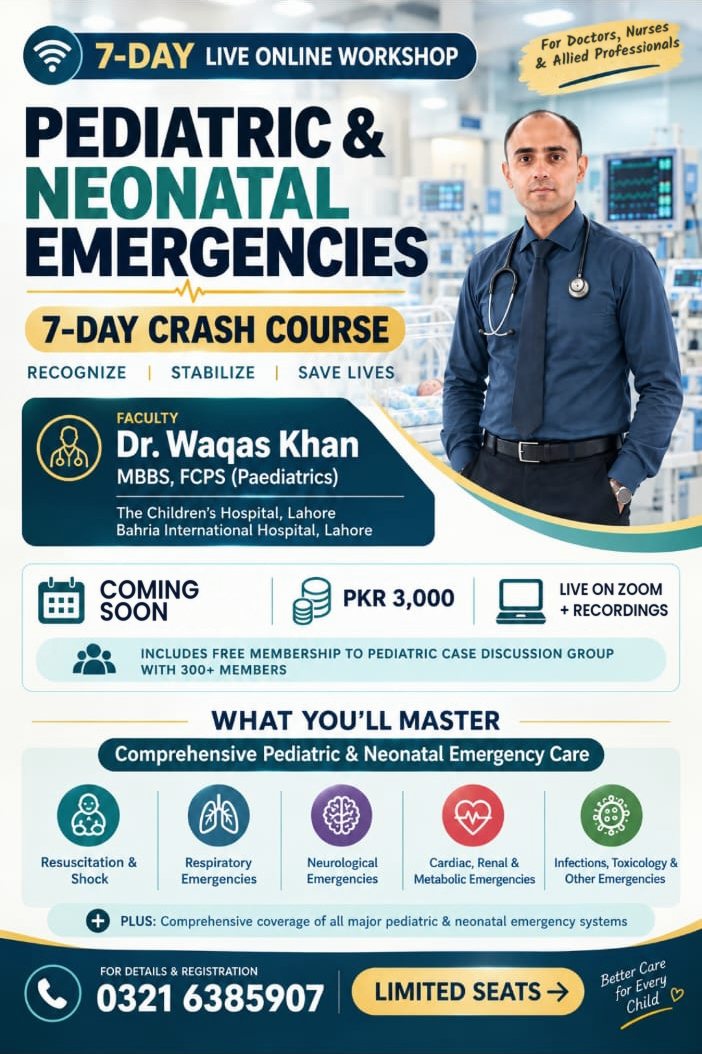
Tap the poster to view it full size, download it, or send it to a colleague on WhatsApp.

Pediatric & Neonatal Emergencies poster: 7-day live online crash course, coming soon, PKR 3,000, with Dr Waqas Khan, MBBS, FCPS (Paediatrics)
Download poster